

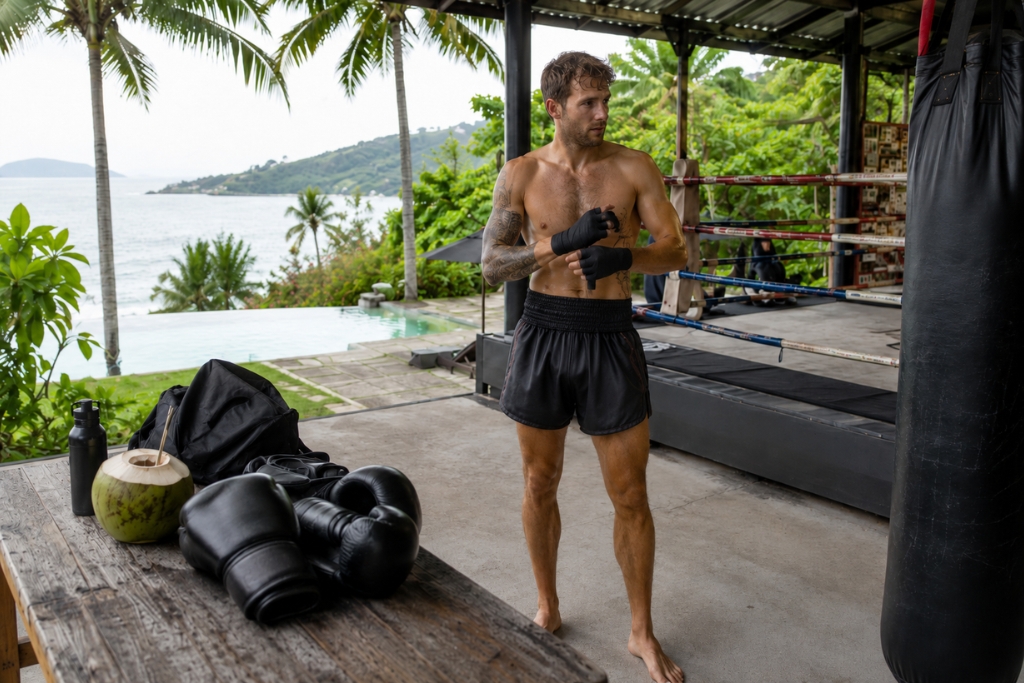
A Muay Thai DTV application requires 500,000 THB or local equivalent held in a personal bank account, plus a letter of acceptance from a Muay Thai gym. Most embassies require 3 months of statements showing that balance at each month-end. Monthly income does not replace the balance under the Soft Power category
The Destination Thailand Visa (DTV) is a five-year, multiple-entry Thai visa permitting stays of up to 180 days per entry. It has two application tracks. The Soft Power category is the DTV track for cultural and sporting activity, including Muay Thai training, Thai cooking courses, wellness programs and medical treatment. The Workcation category covers remote workers and freelancers. This guide covers the Soft Power track only.
How does the Muay Thai DTV differ from the Workcation DTV?
The Muay Thai (Soft Power) DTV and the Workcation DTV share an identical 500,000 THB financial threshold, but require entirely different supporting evidence.
A Workcation applicant submits employment contracts and client agreements, which also demonstrate ongoing income. A Muay Thai applicant submits a gym letter, which proves enrolment and says nothing about money.
This difference in evidence produces 3 practical consequences.
1. Financial evidence carries the entire weight. No contract corroborates a Muay Thai applicant’s circumstances and no employer confirms their income. Thin or recently funded statements have nothing else in the file to offset them.
2. Some embassies and consulates ask how you will support yourself. The Royal Thai Consulate-General in Ho Chi Minh City requests salary proof under Soft Power, asks unemployed applicants to state how they will sustain themselves, and asks applicants to explain their plans after training ends and how they will finance a 5-year stay. A Workcation applicant answers that with a contract. A Muay Thai applicant answers it in writing.
3. Gym legitimacy becomes part of the application. A Thai commercial entity is vouching for the applicant. New Delhi and Kuala Lumpur have taken this to the point of refusing private gym letters altogether.
Guidance stating that income can replace savings was written for Workcation applicants. It does not transfer to the Soft Power category.
How much money do I need for a Muay Thai DTV visa?
500,000 THB, or the local equivalent published by the embassy or consulate handling your application. This money sits in your account. You do not pay it to the Thai government.
Published local equivalents as of 29 July 2026, drawn from our DTV requirements by country reference:
|
|
|
|---|---|
| Washington | $16,000 |
| Los Angeles | $17,000 |
| London | £11,000 |
| Brussels, Paris, Helsinki | €15,000 |
| Rome | €12,500 |
| Cairo | 850,000 EGP |
| Dhaka | 1,750,000 taka |
| New Delhi | 1,000,000 INR |
Meet the figure your embassy or consulate publishes. Do not convert 500,000 THB at today’s rate and assume it qualifies.
Does the 500,000 THB have to stay in the bank for 3 months?
At most embassies, yes, and the balance must sit above the threshold at each month-end rather than on your download date.
Statement seasoning is the practice of holding funds in one account long enough to establish a credible financial history. Three months at most embassies handling Muay Thai DTV applications. Transferring money on Monday, downloading a certificate on Tuesday and applying on Wednesday is the most common financial failure in these applications.
The Royal Thai Embassy in Oslo states the test as “bank statements showing an ending balance of at least 500,000 THB over the past three months.” Washington requires “a copy of a recent saving or checking bank statement for the last 3 months with an ending balance of no less than 500,000 THB or ($16,000 USD) that shows the applicant’s name and date.”
Published holding periods vary widely:
| Period | Embassies or Consulates (as of 29 July 2026) |
|---|---|
| 3 months | Singapore, Washington, Oslo, Brunei, Phnom Penh, Berlin, Kuala Lumpur, Manila, Bern, Cairo, Vientiane, London, Canberra |
| 3 to 6 months | The Hague |
| 6 months | Budapest, Ho Chi Minh City, Yangon, Dhaka |
| Balance dated within 30 days | Brussels |
Brussels inverts the usual logic, requiring an “official bank statement with a minimum credit balance of €15,000 dated within the last 30 days” — recency instead of history.
Silence is not permission. Vientiane publishes no seasoning period, and applicants report close scrutiny of recent large transfers there. Officers at posts with no stated period still assess whether the money is genuinely yours.
If your balance dropped below the threshold, build 3 new clean month-end statements before applying. If your embassy or consulate requires 6 months, build 6.
Why do recent lump-sum transfers cause refusals?
A large deposit shortly before application raises one question: is this your money, or was it borrowed to pass the check?
Insufficient seasoning was the most frequent financial problem across Petchnumnoi DTV applications between January and June 2026, and it ranks among the most common DTV application mistakes we see. The pattern repeats: the applicant has enough money overall, moves it into one account shortly before applying, and produces a strong closing balance sitting on top of a nearly empty history.
Dhaka addresses this directly, requiring bank statements “of the last 6 months with satisfactory transaction” and at least 1,750,000 taka “remained in the bank account for 6 months straight.” The phrasing targets exactly this pattern.
A recent transfer is survivable when you evidence its source. Property sales, investment maturities, inheritances, business distributions and transfers between your own accounts all explain themselves with documents. Attach the relevant items:
- Sending-account statement showing the funds leaving your other account
- Transfer confirmation from the sending bank
- Sale agreement for a property or asset disposal
- Investment maturity notice from the institution
- Dividend or distribution record from the paying company
- Probate or inheritance documents naming you as beneficiary
Names, dates and amounts must reconcile across those documents. A two-line factual explanation beats a page of personal narrative that does not tie to the paperwork.
Time solves this better than documents. Move the funds early and leave them in one account. If you have already been refused on this basis, work through the DTV rejection next-step playbook before reapplying.
Not sure whether your financial documents are ready?
Review the Petchnumnoi DTV application process before submitting. See how your training documents, financial evidence and application stages fit together.
Will paying for my training package break my proof of funds?
Yes, if you pay from the same account and the debit lands before your final statement closes. This failure is specific to Soft Power applicants and it is entirely avoidable.
Muay Thai DTV applications are stronger when the applicant can evidence payment, or a substantial deposit, against the training package. 6-month and 12-month packages are expensive. Paying one out of a proof-of-funds account mid-cycle drops the month-end balance below 500,000 THB, damaging the financial evidence while strengthening the activity evidence.
3 fixes work:
- Pay from a separate account. The gym receipt still evidences payment and the proof-of-funds statements stay untouched.
- Budget training costs above the threshold. Treat 500,000 THB as untouchable and fund training, flights and living costs separately. Check current training prices and schedules so you can budget above the threshold rather than through it.
- Do not allow the proof-of-funds balance to fall below the applicable threshold until the visa has been decided. Pay training fees from a separate account or maintain sufficient funds above the threshold to cover the payment.
Do not pay a large deposit mid-cycle and rely on the officer inferring why the balance fell. A statement line rarely explains itself, and Washington warns that unclear documents lead to additional requests and delays.
What must a Muay Thai DTV bank statement show?
A Muay Thai DTV bank statement must show 8 elements for an officer to verify it without guessing:
- Your full name, matching your passport
- The bank’s name and branding
- The account number, partial masking accepted
- Statement start and end dates covering the full required period
- Account currency
- Opening and closing balances for each month
- Complete transaction history for the period
- A current issue or download date
Washington and Helsinki both specify “a copy of a recent saving or checking bank statement… that shows the applicant’s name and date.” Term deposits and notice accounts are weaker even at adequate balances, because 4 embassies reviewed — Washington, Helsinki, and Cairo — name savings, checking or current accounts specifically.
Certification standards differ by post. Cairo accepts an “original stamped saving or current account bank statement only.” Dhaka states that “only original Bank Statement and Bank Solvency Letter are acceptable.” Budapest requires an official bank statement. Prague requires financial evidence in English or Thai. Washington warns that screenshots and unclear files trigger additional-document requests and delays, which is consistent with the tightening of DTV application guidelines across posts.
Three things sink otherwise adequate statements. Never submit a mobile banking screenshot of a current balance. Never crop out your name, dates or currency. Never remove transaction history because it shows ordinary spending. Officers expect a real account in real use.
Which financial evidence do Muay Thai DTV officers accept?
Six categories of financial evidence appear across the embassy requirement lists reviewed in July 2026. A personal savings or checking account with a clean history is the strongest of them.
| Personal savings or checking account | Strongest | Washington, Helsinki, Moscow and Cairo specify savings, checking or current accounts. |
| Joint or family account | Often accepted | Washington, Los Angeles and Helsinki accept family statements with proof of relationship. |
| Sponsor’s account | Embassy-specific | Listed by at least 7 embassies including London, Washington, Budapest, Brunei, Ottawa, Santiago and Copenhagen. None publishes acceptable sponsor relationships. |
| Payslips and recurring income | Supporting evidence | Listed on many official pages. No embassy or consulate publishes an income-only threshold. Ho Chi Minh City treats salary proof as additional to the balance. |
| Brokerage or investment account | Rejected at some posts | Budapest and Cairo does not accept investment statements. |
| Cryptocurrency | Rejected at some posts | Most embassies does not accept crypto statements. |
Based on our experience with two recent clients, the Moscow Embassy may require a confirmation or acceptance letter showing that the applicant has paid for 5 years of training. In one case, the Embassy did not accept a letter covering only 9 months, and the client subsequently requested a refund. However, we have not yet confirmed whether this requirement is still being applied.
For India, applicants were previously asked to provide an additional government-issued letter. More recently, however, one of our clients was approved in New Delhi without submitting this document. It is therefore unclear whether this requirement should still be included, as the Embassy’s document requirements appear to change from time to time.
9 embassies reviewed use an identical open formula listing “money transfers, bank statements, pay slips, sponsorship letter” without addressing crypto or investments either way.
Can 50,000 THB per month replace the 500,000 THB balance for a Muay Thai DTV?
Income evidence is not inadmissible: many embassy pages list payslips among acceptable financial evidence. But income evidence is also not a substitute for the balance. No official page reviewed states a monthly figure, a qualifying period, or that income replaces the 500,000 THB requirement.
Income evidence is also not a substitute. No official page reviewed states a monthly figure, a qualifying period, or that income replaces the balance rather than supplementing it.
Where embassies and consulates address the interaction, they require both. A Ministry of Foreign Affairs checklist used in Malaysia requires a three-month statement showing 500,000 THB and 6 months of salary evidence. Washington and Oslo publish the three-month requirement with no income alternative. Manila requires an employment certificate alongside three months of statements.
The “50,000 THB per month” figure circulates in guides aimed at remote workers. Do not build a Muay Thai application on it.
Can I use a joint account for a Muay Thai DTV visa?
Yes at several embassies and consulates, provided your name appears on the account and you evidence the relationship. Helsinki states the condition directly: “In case of submitting a family bank statement, proof of relationship (ie birth certificate, marriage certificate) must be provided.” Washington and Los Angeles publish equivalent wording.
Submit a marriage certificate for a spouse, or a birth certificate or adoption record for a parent and child.
One balance does not cover two applicants. Each applicant meets the 500,000 THB requirement individually, including dependants, and no embassy page reviewed in July 2026 permits a shared balance. Two applicants sharing one account therefore need 1,000,000 THB between them. Confirm this before paying two non-refundable fees, which run $400 each in Washington and £300 each in London.
An account in your partner’s name alone is sponsorship, not a joint account, and is assessed differently.
Have another DTV question?
Read Petchnumnoi’s answers to common questions about financial evidence, eligibility, dependants, training documents, application timing and the visa process.
Can someone sponsor my Muay Thai DTV proof of funds?
Yes at many embassies, though none publishes which sponsor relationships qualify. At least 7 posts reviewed list sponsorship letters as acceptable financial evidence: London, Washington, Budapest, Brunei, Ottawa, Santiago and Copenhagen.
Submit 6 items:
- A signed sponsorship letter stating the commitment
- The sponsor’s passport or government identification
- Proof of the relationship between sponsor and applicant
- The sponsor’s official bank statements covering the full qualifying period
- A stated commitment to support the applicant in Thailand
- The sponsor’s address and contact details
The sponsor’s account must meet the full 500,000 THB equivalent over the same qualifying period — three months at Washington and Brunei, six at Budapest. A sponsorship letter alone never suffices, because it describes the arrangement without evidencing the funds. Spouse and parent sponsorship documents more easily than friend or company sponsorship.
Sponsorship also complicates the self-sufficiency question at posts that ask it. Prepare that answer in writing if you are applying through Ho Chi Minh City.
Can I use crypto, stocks or a brokerage account for a Muay Thai DTV?
Most embassies does not accept cryptocurrency or investment statements.
Liquidation timing is the part applicants miscalculate. Converting an asset does not start your seasoning clock — the funds must be settled in the bank account before the first of your qualifying month-ends.
Property, vehicles and business valuations are weaker still, because none evidences accessible living funds. If you are planning to hold funds locally after arrival, note that Thai banking restrictions have tightened separately from the visa rules.
What happens if the exchange rate pushes me below 500,000 THB?
Hold 5 to 10% above the threshold. Whether currency movement can hurt you depends on what your embassy or consulate publishes.
Embassies and consulates publishing a local-currency figure insulate you from exchange-rate risk, because you meet the published number. Washington publishes $16,000, Los Angeles $17,000, London £11,000, Brussels €15,000 and Rome €12,500. Washington and Los Angeles publish figures $1,000 apart for the identical 500,000 THB requirement — a 6.25% spread between two posts in the same country. Brussels and Rome differ by €2,500.
Embassies and consulates publishing only a baht figure leave you exposed. Vientiane, Phnom Penh and Canberra state 500,000 THB or equivalent without fixing a local number, so a foreign-currency account can fall below the threshold while your underlying balance is unchanged. A 10% strengthening of the baht against your holding currency removes roughly 50,000 THB of headroom.
Where your embassy or consulate publishes a local figure, meet that figure with headroom. Where it does not, hold the buffer.
Do any embassies reject Muay Thai gym letters?
No Royal Thai Embassy publishes a blanket refusal of private Muay Thai gym letters. However, New Delhi and Kuala Lumpur are reported to request additional Thai government or sporting-authority confirmation in practice. Petchnumnoi has encountered applications at Kuala Lumpur where officers asked for confirmation beyond the gym’s acceptance letter. Neither post’s current published checklist states this as policy, so treat it as post-level practice and confirm the documentary position in writing before paying a non-refundable fee.